Worldwide Logistics · CRM Migration + Operations Rebuild

A Migration.
Then A Rebuild.
Their legacy CRM contract was running out. We took the sales team live on HubSpot ahead of the deadline, then turned the migration into a full operations rebuild.
10 wks
Kickoff to go-live, ahead of a hard deadline
2
Phases: a CRM migration, then a full ops rebuild
4
New pipelines built from scratch
1
System of record, replacing scattered tools
02 — The short version
The story in 30 seconds.
The problem. A national freight brokerage running its commercial motion on a legacy CRM whose contract was about to expire. Around it sat scattered email, shared drives full of customer RFPs, and a stack of disconnected systems. No shared view of a customer, and a clock running down.
What changed. We migrated the sales team onto HubSpot before the contract lapsed, then expanded into operations: new pipelines built from scratch, automated pricing and onboarding handoffs, and a cross-team gate that makes the CRM impossible to route around.
The result. Sales went live ahead of the deadline and adoption held through the following quarter, so the work expanded into operations. The migration became the foundation for a broader rebuild, not the finish line.
Why it stuck. We sequenced it as a process change, not a software install: a control-group-first rollout, structural gating that forces real usage, and a deliberate decision to keep the field team on the tools they already trusted.
03 — The problem
A CRM
On A
Deadline.
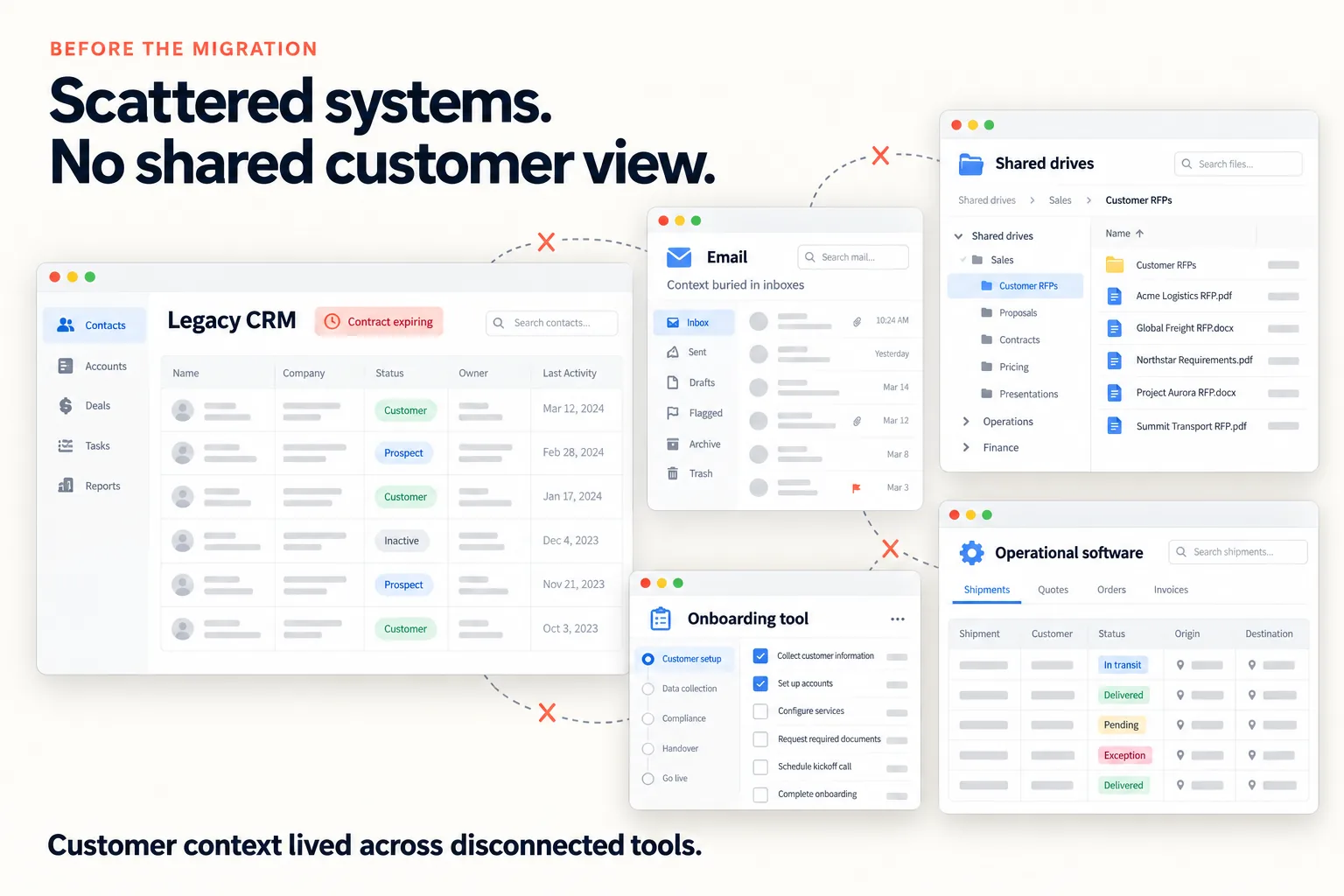
Worldwide Logistics operates a national freight brokerage with teams across sales, operations, pricing, and carrier sourcing. When we arrived, the commercial motion ran on a legacy CRM whose contract was about to expire. Around it sat a sprawl of disconnected systems: email, shared drives holding customer RFPs, a separate onboarding tool, and operational software that did not talk to the CRM. No shared view of a customer.
Pricing intake was a recurring pain. Deals reached the pricing team without the context they needed, so work bounced back and forth and slowed every quote down.
And the migration had a hard floor. The old CRM was going away whether or not the new one was ready. A slipped go-live meant the sales team would be left with no CRM at all, mid-quarter.
WWL did not need another tool. They needed the migration done before the clock ran out, and a system the team would actually use once it was.
04 — What we actually did
Three
Moves.
01
Beat the deadline.
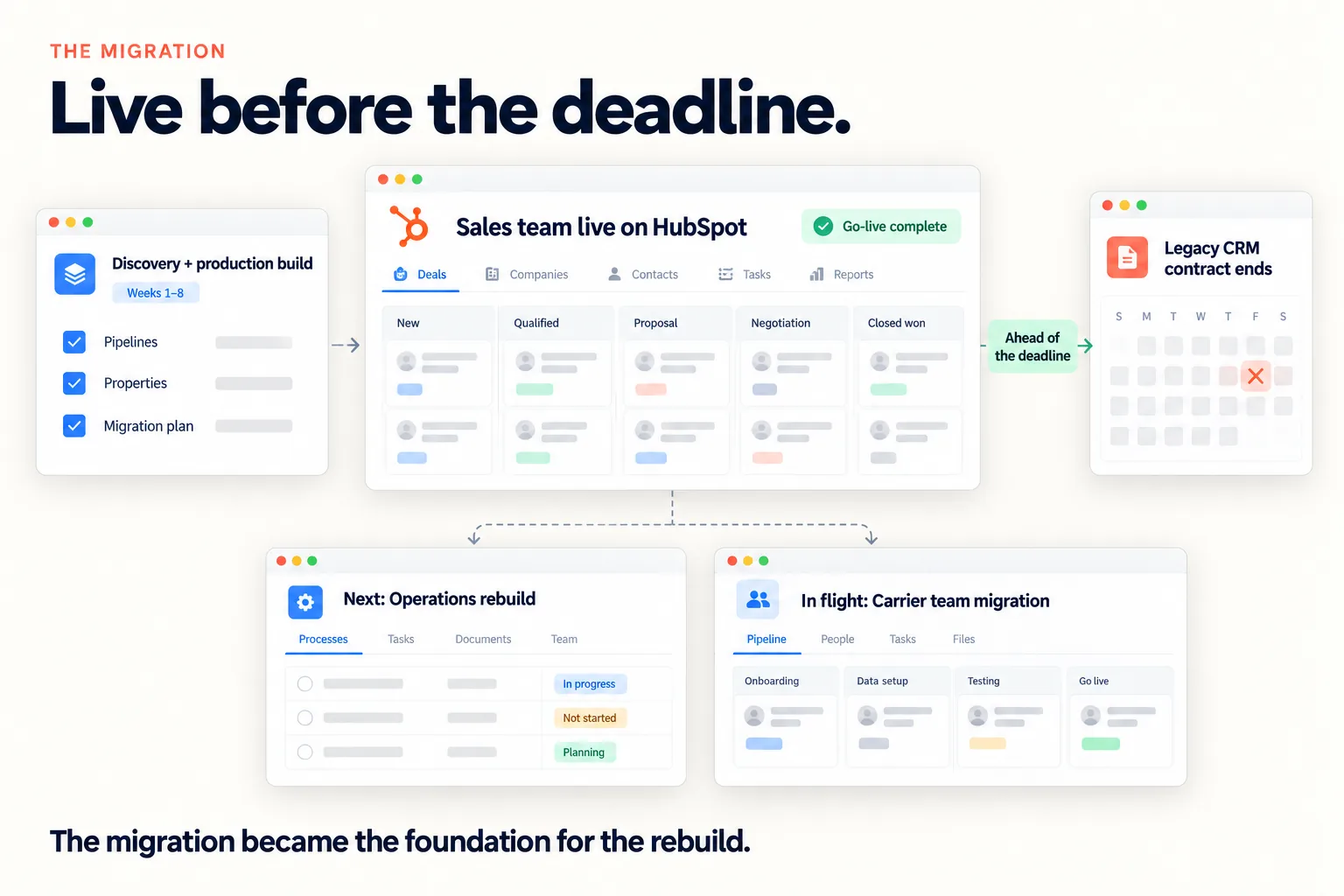
We ran discovery and built in production in parallel and took the sales team live on HubSpot weeks before the old CRM contract expired. One pipeline, one source of truth, no parallel systems to maintain.
Years of duplicate records collapsed with a parent-child company model, so scattered site-level accounts rolled up cleanly into the parent companies that owned them.
02
Built the pipelines they never formally had, plus a gate that forces adoption.
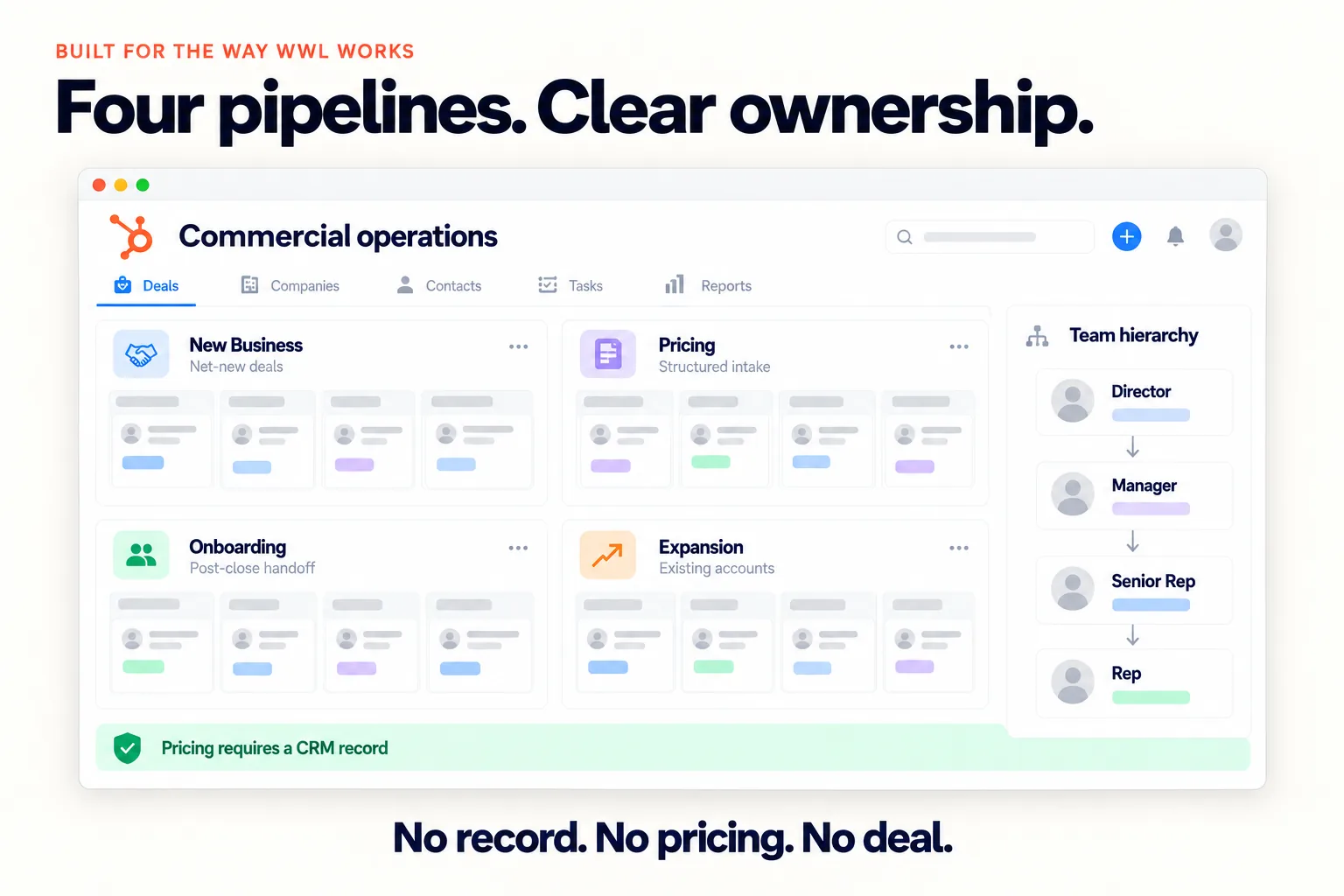
WWL's motion had grown organically: implicit stages, no formal pipeline. We built them, for new business, pricing, onboarding, and expansion, with the team structure mirroring the org so ownership cascades instead of living in a flat owner field.
The adoption mechanism was structural, not a mandate. The pricing team agreed they would not quote a deal that was not in the CRM. No record, no pricing, no deal.
03
Automated the handoffs, and rolled out by control group.
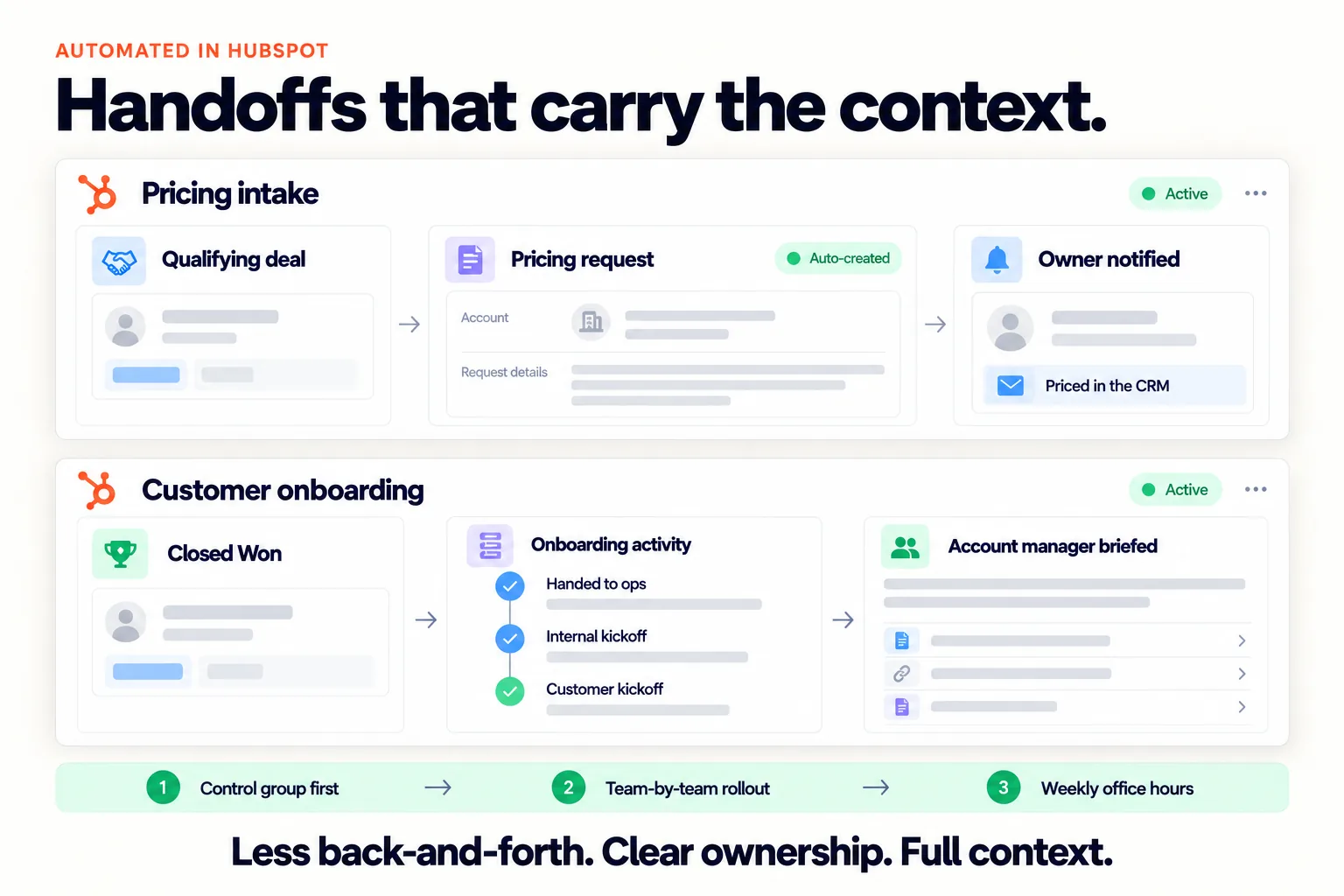
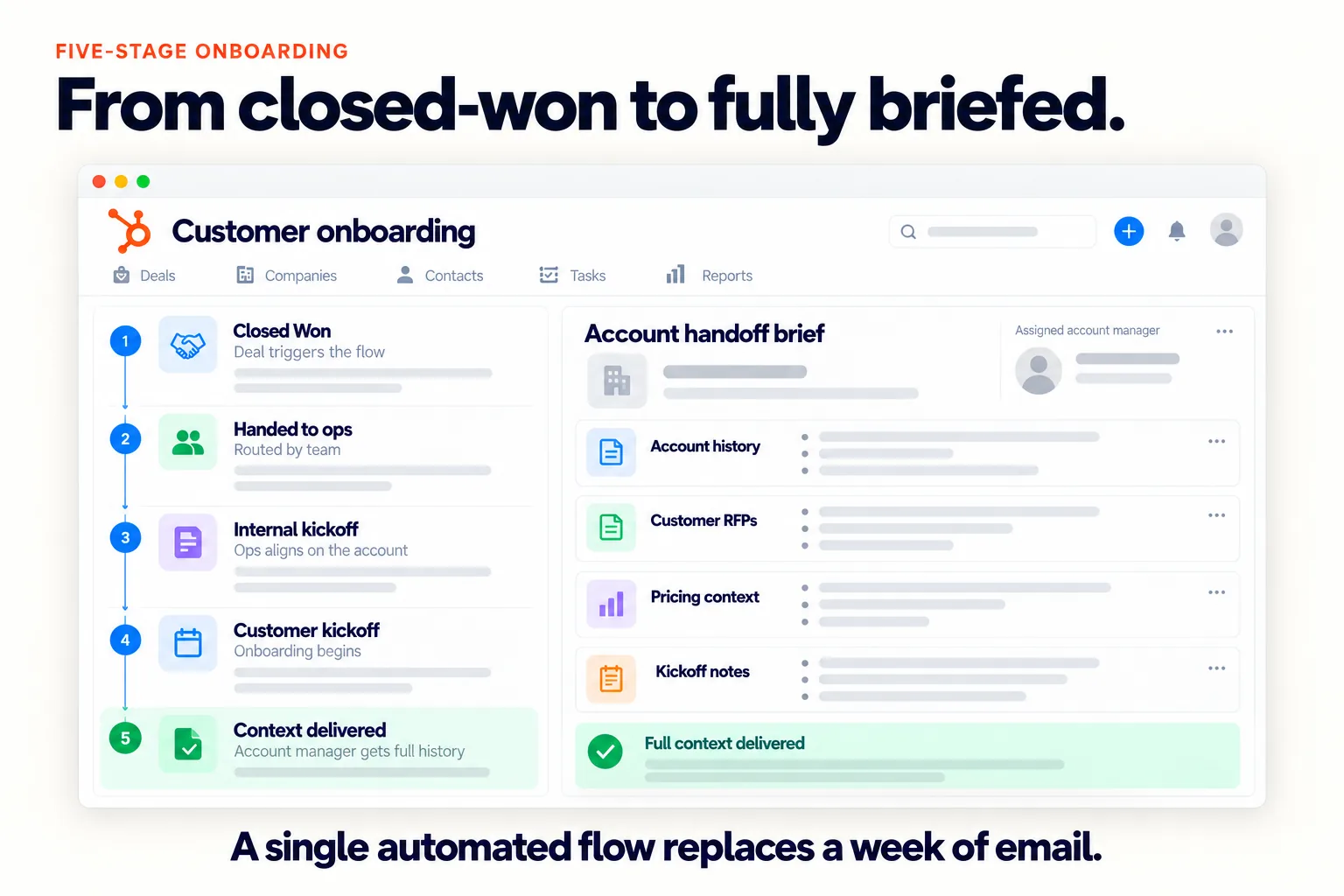
Two processes ate enormous amounts of email: pricing intake and new-customer onboarding. Both run inside HubSpot now. A qualifying deal automatically creates a pricing request and notifies the right owner. A closed deal kicks off a structured onboarding flow that ends with the assigned account manager getting full context automatically, instead of a week of shadowing.
We rolled it out deliberately: a control group first, then team by team, with weekly office hours for the long tail. One scoping call mattered most. We kept the field account-management team on the tools they already trusted rather than forcing them into a CRM they would resent. Their activity still flows into HubSpot automatically.
05 — The result
What
Changed.
Sales went live ahead of the deadline and adoption held through the following quarter, so the work expanded into operations. RFPs that used to live on someone's hard drive are attached to company records. Pricing intake that used to be a hallway ask is a structured request. The handoff that used to take a week of email is automated. The migration became the foundation, not the finish line.
System of record
Legacy CRM, contract expiring
HubSpot, live before the deadline
Pipelines
None formally defined
New business, pricing, onboarding, expansion
Pricing intake
Context lost between teams
Structured request, gated through the CRM
Onboarding handoff
A week of email between teams
Automated flow with full context
Account data
Duplicate site records, hard to match
Rolled up cleanly under parent companies
What We Deliberately Did Not Do
Kept the field team on their existing tools
Their quoting tools already worked. Activity still flows into HubSpot automatically, so no context is lost.
Left high-volume spot quotes out of the main pipeline
One-offs route through a lean transactional flow instead of clogging the deal pipeline.
No big-bang go-live
A control group went first, then teams followed, with weekly office hours for the long tail.
Adoption you do not have to fight for is adoption that lasts.
06 — Sound familiar?
If three hit home, we should talk.
You have a CRM contract running out and a migration that cannot slip.
Your team still lives in email threads and shared drives for customer context.
You have multiple siloed tools, and no single source of truth for a customer.
Onboarding a new rep takes weeks because account history lives in people's heads.
Your pricing or handoff processes still happen over email and hallway conversations.
20 minutes. No deck. We'll tell you whether we can help or not.
07 — FAQ
Questions we get asked.
Did this replace their old CRM?
Yes. The old CRM contract was expiring, so the first phase migrated the sales team onto HubSpot before the deadline. HubSpot became the customer-facing system of record for pipelines, activities, and communications. It coordinates with the operational systems that remain rather than the CRM that was retired.
How long does a migration like this take?
The first-phase migration ran about ten weeks from kickoff to go-live, compressed by a hard contract deadline. The full operations rebuild that follows, new pipelines, automated handoffs, phased rollout, is a multi-month engagement. Treat the go-live as the starting line, not the finish.
How do you get adoption from a team that has always lived in email and shared folders?
Mostly by making the system impossible to route around for the work that matters, and easy to ignore where it does not. Here, the pricing team agreed not to quote any deal that was not in the CRM, which forced the record to exist. We automated the handoffs that used to require email chains. And we deliberately kept the field team on the tools they already trusted instead of forcing another login.
What happens when a new person joins a team mid-rollout?
Account context follows the record, not the person. When a rep transitions, the incoming person sees full history, previous deals, email threads, onboarding notes, in the CRM record. Handoffs that used to take a week of shadowing take an hour.
Why do most enterprise HubSpot rollouts stall?
Because they are treated as software deployments instead of process changes. The switch gets flipped, training happens in a single day with people who have never touched the system, and adoption decays quietly. The fix is a phased rollout with a control group first, where each cohort is supported into real usage rather than dropped at a blank screen.
08 — Next step
Want
A Rollout
That
Actually
Sticks?
We take on a small number of clients at a time so we can actually do the work. If your team is still living in email and shared drives, 20 minutes will tell us both if we're a fit.
20 minutes. No deck. Straight talk about whether we can help.